KU scholar forms Courageous Minority movement, international group to create conditions for educational revolution
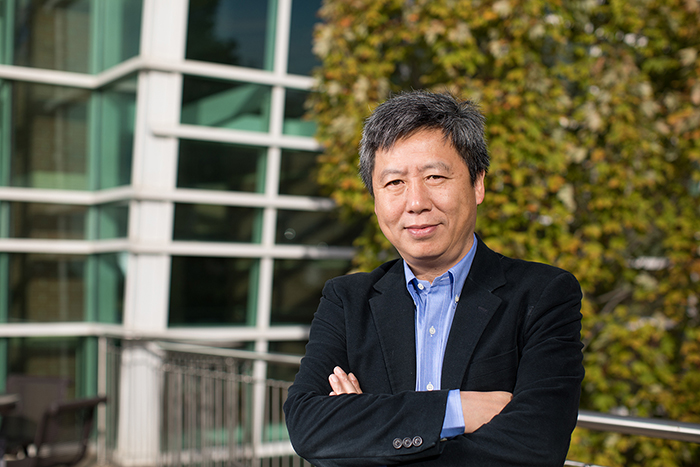
LAWRENCE — Society has been trying to improve and reform schools regularly for decades, yet the fundamental nature of schools has not changed in about 200 years. A University of Kansas education expert has started an international movement and published an article on the need for a “courageous minority” to create the conditions for educational evolution in the age of artificial intelligence.
Yong Zhao, Foundation Distinguished Professor of Education, said that with today’s technology, educators and students have the power to create conditions where students can guide their own learning and not worry about altering the way all schools do business.
Earlier this year, he started the Courageous Minority movement, composed so far of 20 educators from 17 countries on five continents who are committed to reimagining education, exploring the use of technology, discarding traditional curriculum requirements and working together to find new ways to help students guide their own learning.
“Technology hasn’t changed the core business of schools yet, and they still focus on the basics of math, reading, science, etc.,” Zhao said. “In this age, when nobody knows what AI can or should do in education, we should understand that any change for the betterment of students is worth trying. The Courageous Minority movement started with my longtime commitment to making schoolwide transformational change. People tell you AI makes students lazy. Makes teachers lazy. That’s why schools and governments are worried about it. What we need today is thorough change. If you keep doing the same things over and over, eventually AI will be able to do it.”
The first cohort of the movement meets virtually each month, sharing ideas, progress and next steps for action. Zhao also recently wrote an article outlining the basis of the movement and how schools need “the courage to govern less” and avoid the authoritarian temptation to impose strict control. The article was published in the journal Interchange: A Quarterly Review of Education.
In challenging times, people tend to want strong leadership. That has shown up in politics repeatedly throughout history, and education is not immune as schools are political entities controlled by elected officials and government bodies, according to Zhao.
What’s needed is not a lack of leadership, but leaders who understand they can give teachers the freedom to try new things without dictating exactly what that is or how it should be done, he wrote.
Schools also serve as a peace treaty, in effect, Zhao wrote. Varied interests from politicians to parents, students, administrators and community members all have goals for schools and things they want from education. A negotiated peace between those interests has put education in the largely intractable state it has been in.
Zhao wrote that it has also resulted in mandated changes and approaches to reform such as recent efforts like the science of reading or social/emotional learning, which mean well but inadvertently assume all schools and students operate and learn alike. They also give students very little agency over their own learning and begin from the assumption that schools across the nation can and should make the same changes.
“Students are very capable. Many governments say we should ban phones or iPads, but students always find ways around those rules and still need to deal with modern technology,” Zhao said. “Any change, at any level, is worthwhile. Not every change should be scaled up or tried to be made sustainable. Students have access to technology and the ability to help make changes.”
Education and leadership need the courage to govern less, according to Zhao. People often point to China’s remarkable economic growth of the last 20 years. A native of China, Zhao said people misunderstand how and why that growth happened. Instead of the government dictating improvements and economic progress, results happened because the nation’s government gave citizens the ability to experiment with new ideas and innovate with the freedom to either succeed or fail on their own terms. That approach filtered into the nation’s schools and is an example of how allowing people to try new ideas can bring about more success than forcing change, he added.
The Courageous Minority movement and supporting article are extensions of Zhao’s previous work in reimagining education. He has previously written books on China’s school system, such as “Who’s Afraid of the Big Bad Dragon: Why China has the Best (and Worst) Education System in the World,” and breaking out of the failed reform cycle, “Fix the Past or Invent the Future: Moving Beyond One Size Fits All Education.”
He said he plans to work with educators to encourage a minority to have the courage to govern less and make changes in their own schools and communities.
“Every school leader needs to understand their job. They need to create the conditions for learning and realize individuals may have good ideas and not impose their ideas on others,” Zhao said. “School change has always been about trying to scale up and be sustainable. It’s OK to want that, but it hasn’t worked. Education needs to be individualized, not institutionalized.”