Department of Educational Psychology Code
(Articles I-VI)
Article I. The Department
I. Powers of the Department:
The department is bound in its actions by university and school regulations as expressed in the School of Education Code and all other relevant university documents.
II. Conduct of the Department Meeting:
Within limits imposed by the department code, the Chairperson of the department conducts department meetings in the manner most likely to ensure free, open and orderly discussion. When questions of procedure arise, appeal is made to the provisions of Keesey (1994) Modern Parliamentary Procedure which shall be the final arbiter.
Meetings held within department should be forums for advancing ideas, listening to, and discussing differences in a respectful and professional manner. This general ground rule should be followed in all department meetings. Disruptive behavior cannot be allowed to derail the discussion of important issues. Some of these behaviors may include:
- Abusive language
- Derogatory comments or personal attacks on colleagues
- Repeated interruptions or fear of retaliation
- Tears or emotional outbursts
III. Membership:
Voting members of the department shall consist of faculty holding tenure-track or lecturers with a minimum of half-time appointment, continuing appointments in the department, and those students who have been selected as representatives to the department. Faculty who hold non- continuing appointments are encouraged to attend all meetings of the department and to participate fully in its discussions.
IV. Student Representation:
In accordance with university regulations, the number of student representatives shall be no less than 20% of the number of faculty eligible to vote. A student from each of the four program areas in the department and as many ‘at-large’ student representatives that are needed to comply with university regulation shall be chosen. The ‘at-large’ student representatives will be voted in via their fellow academic program organizations.
V. Quorum:
A quorum at department meetings and committee meetings shall consist of a majority of all members eligible to vote.
VI. Voting:
Voting by is typically done at department meetings. Mail ballots may be taken after the meeting if moved by faculty. The discussion that takes place in meetings is an important element in making final decisions on the matter at hand.
VII. Meetings:
Normally, the department shall meet at least once a month during the academic year. The schedule of monthly meetings shall be distributed at the beginning of each academic year. In unusual circumstances, additional meetings may be scheduled, preferably with three working- days’ notice. Attendance at faculty meetings is expected.
VIII. Amendments to the Code:
Any member or standing committee of the department may propose amendments to the department code. Proposed amendments must be distributed in writing and/or electronically at least seven calendar days before the meeting at which they are to be discussed. A majority of all members eligible to vote is necessary for amendments to be adopted.
Article II. The Department Chairperson
I. Responsibilities:
The Chairperson, who is responsible for providing collegial leadership for the department, is the administrative head of the department. He or she chairs department meetings and is the representative of the department to other departments, divisions and administrators of the university except in those cases when he or she or the department specifically designates another member of the department to act in that capacity.
The Chairperson is responsible for carrying out the policies and regulations established by the department faculty and for representing the views of the department. This does not inhibit the right of the Chairperson to make necessary administrative decisions or speak as an individual faculty member.
At the beginning of each fall semester, the Chairperson shall prepare and distribute to members of the department a calendar of regular department meetings for the academic year.
The Chairperson shall prepare and distribute an agenda for each regularly scheduled department meeting at least five business days before regularly scheduled meetings, along with copies of any documents to be acted on during the meetings.
II. Annual Performance Review:
The Chairperson is responsible for completing an annual performance review of all other faculty members and lecturers. This review will be done in the spring term and includes information from the previous calendar year provided by both the faculty members and staff. The Chairperson shall review each dossier and provide a written evaluation letter to all faculty and lecturers before the end of the spring term. The Chairperson uses the evaluation data for each faculty member and lecturer for determination of merit salary increases. This work of the Chairperson is done in line with policies outlined in Article V.
III. Term:
The term of office of the Chairperson shall be determined by the dean, who after consulting with the provost, shall make the initial appointment and all subsequent reappointments for specified terms not to exceed five years.
Article III. Committees
I. Standing Committees:
A. Organization of Standing Committees:
Each standing committee is constituted as described below in Article III. 1.3. New committee members and officers begin their terms on July l, following spring semester elections or appointments. A Chairperson of each committee is selected by the Department Chairperson. No standing committee shall take action unless a majority of the members support the action.
B. Voting Status:
i. Department Chairperson:
The Chairperson may be invited to attend any departmental committee meetings at the discretion of the committee members. The department Chairperson or associate Chairperson has ex-officio, non-voting status at these committee meetings.
ii. Faculty:
Faculty status and attendant voting privileges at the department level are defined in Article I, Section 3 above.
iii. Voting on Tenure and Promotion:
In tenure and promotion personnel actions, all tenured faculty may vote only on candidates for equal or lower rank.
C. Standing Committees:
i. Personnel Committee:
The membership of the personnel committee shall consist of four tenured or tenure-track faculty members in the department representing each of the departmental areas. Members shall normally serve two-year terms with no more than two of the memberships changing each year. Committee members shall be nominated and confirmed at the end of each academic year. Whenever possible, at least two members shall be full professors. No assistant professors may be on the committee. Whenever possible, a full professor shall chair the committee and the Chair shall have served on the committee previously.
Only members of the personnel committee may attend the department's personnel committee meetings. Additionally, personnel committee members who are being actively evaluated for tenure, promotion, mid-probationary review or sabbatical leave must be replaced for the duration of the review period by another departmental faculty member, who is appointed by the committee Chairperson.
Any untenured member of the committee must be replaced by a tenured faculty member appointed by the committee Chairperson for work related to the promotion and tenure process (P&T Review committee).
The departmental personnel committee is responsible for implementing and reviewing the personnel policies of the department. These include the following tasks.
- Conduct reviews and make recommendations regarding sabbatical leave requests and promotion and tenure applications.
- Manage reviews and submit recommendations to the department with regard to mid-probationary reviews and courtesy faculty appointments.
- Review school and departmental personnel related policies as necessary.
- Review the department code on matters related to personnel and propose changes to the department code if deemed necessary.
Those serving on the department personnel committee shall not serve on the University Committee on Promotion & Tenure, the University Committee on Sabbatical Leaves, or the School of Education Personnel Committee. The Department Chairperson shall not serve on the department personnel committee. All department faculty of appropriate rank may participate in departmental discussion of candidates applying for promotion and/or tenure.
ii. Graduate Program Committees
The graduate admissions program committee is responsible for developing and evaluating policies and procedures for the graduate student applications and admissions and for evaluating all graduate student applications submitted for departmental graduate programs. The membership shall be determined by the each program. The committee duties shall be:
- Review and revise written policies and procedures for application and admissions to departmental graduate programs.
- Develop a rubric for evaluating and rating applications to graduate programs.
- Review all applications submitted to the program for the masters, educational specialist or doctoral programs and make recommendations acceptance or denial into the programs.
D. Ad Hoc Committees:
i. Search Committee
The department will constitute a search committee for hiring faculty or unclassified staff. The Chairperson of the department will appoint a Chairperson for the search committee. The search committee will include five members including two from the home program in which the new faculty member will reside and two additional faculty and one student. The search committee may have any tenure-line faculty member or lecturers and faulty can come from within or outside the department as determined by the Chairperson of the search committee.
The search committee will be responsible for preparing search documents and coordinating the search with Human Resources, the Chairperson, the faculty and staff. The search committee will screen applications and give the faculty adequate time to review the files. The search committee will present to a meeting of the department a ranked list of the candidates considered to be most qualified to be interviewed. After feedback from the faculty has been received the search committee may re-rank the candidates and work with the Chairperson to invite the final list of candidates for a campus visit.
After all the candidates have visited campus, the Chairperson of the screening committee shall request written feedback on the candidates from all faculty and staff in the department. The Chairperson of the department shall call a department meeting to discuss the relative merits of the candidates. The Chairperson of the screening committee shall summarize the strengths and weaknesses of the candidates as reflected in the discussion of the screening committee and the department. When the dean and/or Chairperson of the department disagree with the recommendation of the department, a meeting of the department shall be called to attempt to resolve the disagreement. The Chairperson of the department is responsible for communicating the final selection to the applicants.
In the event all acceptable candidates decline offers or are deemed unacceptable, the screening committee shall consider additional candidates who were not previously interviewed, or shall re-advertise the position to solicit more applicants. The screening committee shall then present the most qualified candidates to the department for consideration and repeat the process until the position is filled or the search is terminated.
ii. Post-Tenure Review Committee
Post-tenure review is conducted by the Unit’s Personnel Committee, which shall consist of three tenured faculty members selected in accordance with the unit’s by-laws. One tenured professor from each program will serve as a representative on the Personnel Committee.
No person may serve on the committee if his or her spouse or partner is scheduled for review. A committee member who believes that there may be a significant conflict of interest should withdraw from the committee. If a faculty member who is undergoing review believes that there is a conflict of interest, he or she may object to the inclusion of a member. If the member declines to withdraw, the remaining committee members shall consider the basis for the alleged conflict and decide the matter. If a committee member withdraws or is removed based on a conflict of interest, the Chairperson will name a replacement.
The committee will review the file and evaluate the faculty member’s overall performance and his or her contributions in the areas of teaching, scholarship, and service. Applying the expectations defined above, the committee will determine whether the faculty member’s performance in each area, as well as whether his or her overall performance meets expectations, exceeds expectations, or fails to meet expectations. In making its evaluations, the committee must bear in mind that (1) faculty members have differing responsibilities and make different kinds of contributions to the mission of the Unit, the School, and the University; (2) a faculty member’s activities vary over time according to his or her strengths, interests, and career path; and (3) innovative work may take time to reach fruition and may sometimes fail.
The committee will prepare a written report summarizing its evaluation. The report should provide a narrative description of the faculty member’s activities, an explanation of the committee’s ratings, and recommendations or suggestions for acknowledgement of contributions and future development of the faculty member. The committee will provide a copy of the report to the faculty member, who may submit a written response for inclusion in the post-tenure review file before it is forwarded to the Chairperson.
The department Chairperson and/or the department assembly may appoint ad hoc committees to address specialized concerns of the department.
Article IV. Professional Ethics
I. Responsibilities:
[NOTE: The content below is drawn from C. 2. e, Article V. 5 of the KU Handbook for Faculty and Unclassified Staff, page 59.] Faculty members have professional and ethical responsibilities in five dimensions: 1) subject and program areas, 2) students, 3) colleagues, 4) school and university, and 5) community.
- With regard to subject and program areas, faculty members:
- develop and improve scholarly competence
- exercise critical self-discipline and judgment in using, extending, and transmitting knowledge
- practice intellectual honesty
- respect subject and program area expertise
- With regard to students, faculty members:
- encourage the free pursuit of student learning
- demonstrate respect for students as individuals
- serve as intellectual guides and academic counselors
- foster honest academic conduct
- evaluate students fairly
- respect confidential nature of relationship between faculty members and students
- avoid exploitation, harassment, or discriminatory treatment of students
- acknowledge academic or scholarly assistance from students
- With regard to colleagues, faculty members:
- recognize obligations as a member of a community of scholars
- do not discriminate against or harass colleagues
- respect and defend the free inquiry of colleagues
- exchange criticism and ideas with due respect for the opinions of others
- acknowledge academic or scholarly assistance from colleagues
- strive to be objective in professional judgment of colleagues
- accept and actively engage in their fair share of faculty responsibilities
- With regard to Department of Educational Psychology, School of Education, and University of Kansas, faculty members:
- seek to be exemplary teachers and scholars
- give due regard to their paramount responsibilities within their institution
- recognize the effect of interrupting or terminating service and give due notice of their intentions
- With regard to community, faculty members:
- demonstrate rights and obligations to other citizens
- speak or act as private persons in such a way as to avoid creating the impression
of speaking or acting for their university or colleagues - understand that the profession depends upon freedom for its health and integrity
- promote conditions of free inquiry
- further public understanding of academic freedom
II. Resolving any perceived or actual violations:
Faculty members are expected to discuss any perceived or actual violations of these ethical standards directly with the involved individual(s). Following this conversation, the faculty member may approach the Chairperson and/or Executive Committee for additional expertise and problem solving as necessary. This process is intended to inform all involved individuals about the status of the concern and to formulate an appropriate resolution.
Article V. Merit and Performance Evaluation Policy
Introduction: The Department of Educational Psychology supports peer review and evaluation because it is consistent with both the mission of the School of Education and the principle of self- regulation for professional groups. Two ends are served by peer review as it relates to merit and performance evaluation: recognition of contributions to the discipline and the institution, and to the growth of individual faculty members.
The Department intends for its merit and performance evaluation procedures to promote excellence, as this is conceived by the School of Education and the University of Kansas and to align with the criteria valued in the larger academic communities to which EPSY faculty belong.
Statement of Performance Expectations:
A. Assumptions:
The Department recognizes that it is inherently difficult to make judgments about the quality of individual performance in the domains of professional life. The following guidelines are offered, in that case, to assist the Chairperson in performing evaluations of one another’s work in a given period (usually a year). The areas and weights (unless otherwise specified by faculty contract) to be considered in the evaluation process include:
- Scholarship (40%)
- Teaching (40%)
- Service (20%)
B. Materials to be Submitted
The dossier for the annual review is prepared by the faculty member. The dossier should include:
- Departmental Summary Form
- Current Curriculum Vita
- Course Evaluations
- Exhibits
C. Scholarship
Introduction: Consistent with institutional expectations, EPSY faculty members are expected to produce research and other scholarly work each year with an ultimate goal of contributing to our understanding of psychological and educational phenomena. This document is designed to provide clarity and direction for research activities of the tenure-line faculty in the EPSY Department. For the annual review, scholarship is defined annually through the accumulation of Scholarship Units (SUs).
Assigning Scholarship Ratings: Scholarship activities are divided into major and minor categories. Major scholarship activities are converted into SUs using Table 1 (below) and provide entry into a rating category (Table 2). Minor scholarship activities (Table 3) are used to adjust the final scholarship performance rating level (Table 4) WITHIN a category but cannot change the final scholarship performance rating to higher rating level. The maximum scholarship performance rating level in a given year is 4.0.
Table 1 Major Scholarship Activities
| Major Scholarly Activity~ | Scholarship Unit (SU) |
|---|---|
| International and national peer-reviewed journal publication | 1.5 |
| Authored, coauthored book, 1st edition only | 4 |
| Authored, co-authored book, revision# | 2 |
| Authored, co-authored edited book | 1 |
| Chapter(s) in edited book(s) | 1 |
| PI/Co-PI external research grant >$50K, first year of award only | 1 |
| PI/Co-PI external research grant > $100K, first year of award only~ | 2 |
| Unfunded external grant proposal | .5 |
~High impact publications or external grants over $1 million may receive additional SU's per Chair discretion #presumes authorship on first edition
Table 2 Base Scholarship Categories
0 (Poor) = 0 SUs
1 (Marginal) = 1 SUs
2 (Good) = 2 SUs
3 (Very Good) = 3 SUs
4 (Excellent) = 4 or more SUs
Table 3 Minor Scholarship Activities
Minor Scholarship activities increase within category ratings only. Each minor scholarship activity contributes .1 SU's. Maximum SU contribution across all activities in a given year is .5.
- Presentation at international or national meetings
- State/Regional presentation
- Technical report
- Internally funded grant
- Book review or test review
- Discussant for symposium or paper presentation
- Encyclopedia entry
- Symposium organizer for a professional meeting
- Member of a panel at a professional meeting
Table 4 Scholarship Performance Rating Levels
0-.9 = Poor (well below dept. expectations)
1-1.9 = Marginal (below dept. expectations)
2-2.9 = Good (dept. expectations)
3-3.9 = Very Good (above dept. expectations)
4.0 = Excellent (well above dept. expectations)
All scholarship products count in the year they are published or in print. All scholarship activities must be recorded in the KU Professional Record Online (PRO) with an annual report generated by each faculty member annually in January.
D. Teaching
Introduction: Teaching is a primary function of the University, which strives to provide an outstanding education for its students. The evaluation of teaching includes consideration of syllabi, course materials, and other information related to a faculty member’s courses; peer and student evaluations; a candidate’s own statement of teaching philosophy and goals; public representations of teaching; and other accepted methods of evaluation, which may include external evaluations. High quality teaching is serious intellectual work grounded in a deep knowledge and understanding of the field and includes the ability to convey that understanding in clear and engaging ways. The conduct of classes is the central feature of teaching responsibilities at KU, but teaching also includes supervising student research and clinical activities, mentoring and advising students, and other teaching-related activities outside of the classroom.
Assigning Teaching Ratings: The record must demonstrate effective teaching, as reflected in such factors as command of the subject matter, the ability to communicate effectively in the classroom, a demonstrated commitment to student learning, and involvement in providing advice and support for students outside the classroom.
Documentation used for the evaluation of classroom teaching is the “Student Survey of Teaching.” The department considers the scores achieved by the candidate and the student “comments” in each course taught by the candidate in light of the size and nature of the course and any other relevant factors of which it is aware. In addition, candidates may submit information about teaching awards, handouts, assignments and examinations or any other information the candidate believes demonstrates teaching performance. Advising and academic committee service are evaluated by the number of students served and any other evidence that the candidate chooses to submit such as testimonials of students and faculty.
In the case of non-teaching faculty and unclassified academic staff, professional performance, as defined by the unit and the expectations of the discipline, may be evaluated instead of teaching. The weight given to professional performance shall be determined by the particular responsibilities of the candidate. Each administrative unit with nonteaching faculty shall establish standards of professional performance, commensurate with the standards for teaching established in these regulations, to evaluate nonteaching faculty for promotion to equivalent ranks. Throughout this Article, references to teaching and its evaluation should be understood to include professional performance and its evaluation as appropriate to the positions and responsibilities of nonteaching faculty and unclassified academic staff.
E. Service
Faculty are expected to engage in service to various levels of the university, to their academic fields, service to local, regional, and state entities and to the corresponding field of practice. Aspects of service to the department include attendance at faculty meetings and program, department, and school committees. Faculty must provide evidence of involvement in scholarly associations at the national/international level. Documentation of service need only be done on the annual review document—no independent documentation is required.
V.F. Appeal
If a faculty member disagrees with a rating(s) received in the annual review process, he/she may appeal the rating. Appeals, including the basis of the appeal, must be made in writing to the Department Chairperson within ten working days of receipt of the Annual Evaluation Letter. The Chairperson will review the appeal and dossier and make a final decision in case of appeal. The department Chairperson will then make a final decision on the faculty rating.
Important Dates
| February 1 | Annual reports due. (Note: Faculty will be notified by the Chairperson of the personnel committee if their report is late. If a faculty member’s report is late the annual report may not be considered by the personnel committee.) |
| April 15 | Evaluations communicated in writing to faculty. |
| June 15 | Notification to faculty of merit salary increases. |
Article VI. Post Tenure Review
Department of Educational Psychology
Post-Tenure Review (PTR) Criteria and Procedures
Approved by PRE Faculty on April 18, 2014
General Principles: In accordance with Board of Regents requirements, Article 7, section 4 of the Faculty Senate Rules and Regulations, and the University Policy on Post-Tenure Review, the Department of Psychology and Research in Education, hereafter referred to as the Unit, has adopted these expectations and procedures for conducting post-tenure review. Post- tenure review is a process for periodic peer evaluation of faculty performance that provides an opportunity for a long-term assessment of a faculty member’s accomplishments and future directions in the areas of teaching/advising, scholarship, and service.
Post-tenure review must be conducted in a manner that respects the rights of faculty members involved, including academic freedom, tenure, and due process. In addition, all those involved in the evaluation process must recognize that it is a confidential personnel matter and take appropriate steps to protect confidentiality.
Period for Review and Eligible Faculty: Post-tenure review is conducted on a seven-year cycle and covers the seven-year period leading up to the review, including the six prior annual evaluation letters and activities since the last annual evaluation. The cycle is restarted if a faculty member is evaluated for promotion or is awarded a distinguished professorship. Some years may be excluded from the period in accordance with the University policy, and the review may be postponed if the faculty member is on leave during the year of review. Faculty members on formal phased retirement will be exempt from this PTR. The Dean of the School of Education will notify faculty members scheduled for post-tenure review no later than March 15th in the spring semester preceding the academic year of review.
Unit Expectations: All tenured faculty members must meet academic responsibilities in the areas of teaching/advising, scholarship, and service. Unless otherwise specified by the job description or differential allocation of effort, the ordinary allocation of effort is 40% teaching/advising, 40% scholarship, and 20% service.
The Unit has defined its standards and expectations for teaching/advising, scholarship, and service in its annual evaluation procedures. The expectations for post-tenure review are consistent with these standards, with overall productivity commensurate to the seven-year period under review. The following specific criteria shall apply for purposes of post-tenure review.
Process for Determining PTR Expectations for Teaching/Advising, Research and Service
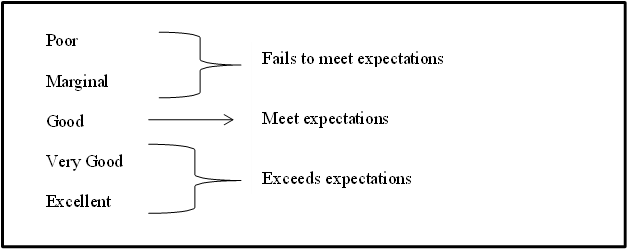
The categorical ratings generated from each of the past annual review documents in research, teaching and service will be averaged over the 6 years of the review cycle and converted into the categories shown below in the PRE Annual review document (see Appendix A). Final determination of the PTR performance category (see Figure 1) will take into account the candidate’s narrative document and the annual review letters provided by the Chairperson.
Relation to the Annual Evaluation. A unit’s post-tenure review policy uses the Faculty Evaluation Policy, however the post-tenure review will be conducted separately from the annual evaluation. The Chairperson will discuss the committee report with the faculty member in conjunction with the annual review process. This discussion should concentrate on the future professional development of the faculty member with an aim toward enhancing meritorious work and improving less satisfactory performance, including adoption of a performance improvement plan, if necessary. Any action on the review that is within the scope of the Faculty Evaluation Policy must be taken under that policy.
Figure 1
Joint Appointments. The faculty member will provide both units with copies of the Faculty Member’s Statement section of the Post-Tenure Review File (reflecting the representative effort in each unit), and a current curriculum vitae. The review goes forward with each unit preparing a separate committee evaluation summary and considerations by each Chairperson and/or director to the dean. In the case of a jointly appointed faculty and unclassified academic staff member, the primary unit is responsible for the administrative protocols of engaging the secondary unit in the solicitation and collection of feedback relative to the evaluation of performance expectations in the secondary unit.
Review Committee: Post-tenure review is conducted by the Unit’s Personnel Committee, which shall consist of three tenured faculty members selected in accordance with the unit’s by- laws. One tenured professor from each program will serve as a representative on the Personnel Committee.
No person may serve on the committee if his or her spouse or partner is scheduled for review. A committee member who believes that there may be a significant conflict of interest should withdraw from the committee. If a faculty member who is undergoing review believes that there is a conflict of interest, he or she may object to the inclusion of a member. If the member declines to withdraw, the remaining committee members shall consider the basis for the alleged conflict and decide the matter. If a committee member withdraws or is removed based on a conflict of interest, the Chairperson will name a replacement.
Preparation of the File: Review will be conducted on the basis of a file that summarizes a faculty member’s teaching/advising, scholarship, and service. In contrast to evaluation for promotion and tenure, copies of publications and original student evaluations are not required. Also, outside reviews of scholarship should not be submitted. 572 The faculty member under review shall provide a brief narrative statement of his or her accomplishments in teaching/advising, scholarship, and service during the review period as they relate to his or her long-term career path and goals. In addition, the faculty member shall submit a current curriculum vitae and a list of additional activities not covered on the curriculum vitae. The Chairperson will furnish copies of the faculty member’s annual evaluation letters for the six years during the review period.
Evaluation and Report: The committee will review the file and evaluate the faculty member’s overall performance and his or her contributions in the areas of teaching, scholarship, and service. Applying the expectations defined above, the committee will determine whether the faculty member’s performance in each area, as well as whether his or her overall performance meets expectations, exceeds expectations, or fails to meet expectations. In making its evaluations, the committee must bear in mind that (1) faculty members have differing responsibilities and make different kinds of contributions to the mission of the Unit, the School, and the University; (2) a faculty member’s activities vary over time according to his or her strengths, interests, and career path; and (3) innovative work may take time to reach fruition and may sometimes fail.
The committee will prepare a written report summarizing its evaluation. The report should provide a narrative description of the faculty member’s activities, an explanation of the committee’s ratings, and recommendations or suggestions for acknowledgement of contributions and future development of the faculty member. The committee will provide a copy of the report to the faculty member, who may submit a written response for inclusion in the post-tenure review file before it is forwarded to the Chairperson.
Consideration by the Chairperson: The committee’s report (along with any faculty response) will be provided to the Chairperson. If the Chairperson agrees with the report, he or she will indicate that agreement in writing to the faculty member and place a copy in the post- tenure review file. If the Chairperson or director disagrees with the committee’s evaluation, he or she shall explain the reasons for any disagreement in writing, with a copy to the faculty member and the committee. The Chairperson may ask the committee to provide additional information or reconsider the review. If the Chairperson disagrees with a positive evaluation by the committee, the faculty member may submit a written response. The Chairperson will forward the file to the Dean of the School.
Consideration by the Dean: The faculty member’s post-tenure review file, including the Unit committee’s report (along with any faculty response) and the Chairperson’s agreement or disagreement, is forwarded to the Dean. Post-tenure review files are due in the School Dean’s Office by no later than noon, on the second Friday in March. The Dean will consider the report and express his or her agreement or disagreement in the same manner as the Chairperson. Following the completion of review by the Dean, if the Dean agrees with the report, he or she will indicate that agreement in writing to the faculty member and place a copy in the file. If Dean disagrees with the committee’s evaluation, he or she shall explain the reasons for any disagreement in writing, with a copy to the faculty member and the unit committee. The Dean may ask the committee to provide additional information or reconsider the review. If the Dean disagrees with a positive evaluation by the unit committee, the faculty member may submit a written response. The Dean will forward a summary of post-tenure review outcomes and copies of the post-tenure review files to the Provost, to ultimately be placed in the faculty member’s personnel file.
Appeals: Following the completion of the review by the dean, if a disagreement between the committee and the Chairperson or Dean cannot be resolved or if the faculty member wishes to appeal an evaluation of “fails to meet expectations” in the overall evaluation or any category of responsibility, the matter will be handled as an appeal under the PRE Annual Faculty Evaluation Policy.
Report to the Provost: The Dean will provide a summary of the results in the School and copies of the post-tenure review file to the Provost. The post-tenure review file will be maintained in the faculty member’s personnel file in the Department and the School of Education.
Approved: